Exploring a guitar pedal as software
Role
Product and interaction design
Scope
Circuit modelling and interface design
Status
Interactive prototype

Circuit / Lab · Independent experiment
An interactive model connecting the TS9 signal path, component choices, familiar controls and audio output.
The starting question
Traditional pedal makers develop products through circuit design, component choices and repeated listening. I used the TS9 signal chain to explore whether that way of working could become an interactive software product.
The simulator connects the circuit, familiar pedal controls and audio output. A change can be made in the model, heard and compared in the same interface.
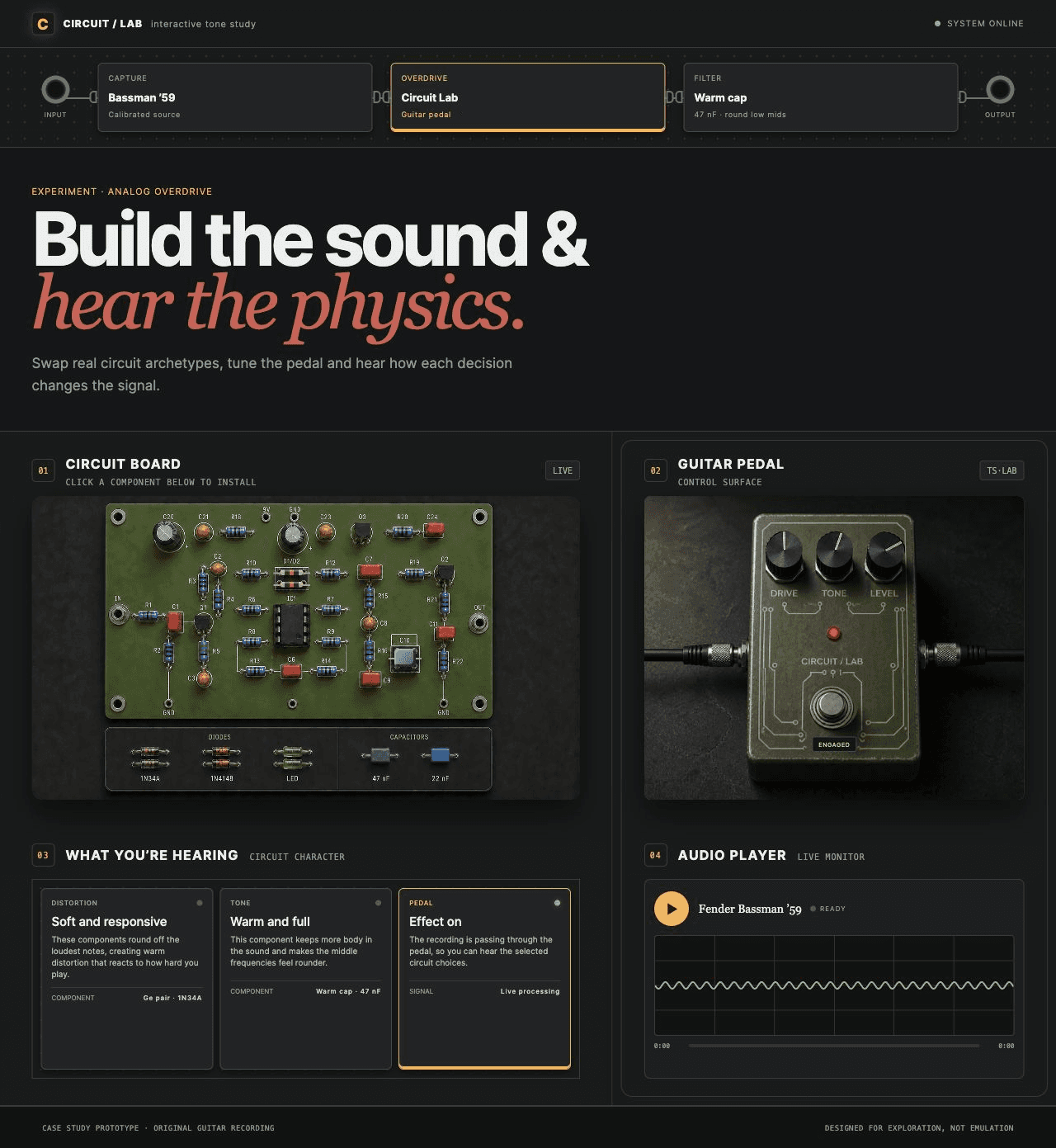
Capturing circuit behaviour
The model follows the main stages of the signal path rather than treating the pedal as three visual controls. Component values, clipping behaviour and the relationship between drive, tone and level shape the output together.
I translated those relationships into editable parameters. The interface shows where a change occurs in the signal path while the audio output makes its effect available for comparison.
Changing the supply voltage
The circuit does not behave the same way at every supply voltage. As voltage falls, available headroom changes and parts of the signal reach their limits sooner. This affects clipping, compression and the character of the output.
Voltage is therefore part of the model rather than a volume control. It allows cases such as a weakening battery or intentionally reduced supply voltage to be explored.
Keeping the maker’s decisions visible
A conventional pedal interface hides most of the component choices and electrical relationships behind three controls. The simulator keeps those layers connected. A manufacturer could decide which parts of its model to expose while keeping proprietary knowledge protected.
Existing circuit practice becomes the basis of the software rather than an appearance copied afterwards. Circuit / Lab makes circuit decisions available to change, hear and compare. It provides something concrete to test with engineers, pedal makers and musicians.
For manufacturers, this suggests a route into digital products that begins with their existing knowledge and working methods.